Chess has a reputation for being complicated, and the rules alone can feel like a wall. They are not. Everything you need to play a complete, legal game fits into a week of short sessions, twenty or thirty minutes a day, with a board in front of you.
This plan takes you from an empty board to a finished game. Work through it in order, because each day assumes the one before. Nothing here expects you to have played before.
Turn the board so the square in your right-hand corner is light. Players remember this as "light on the right"; get it wrong and every game you play will feel strangely mirrored. Then fill the back ranks.
Rooks go in the corners, knights beside them, bishops beside the knights. The queen sits on her own colour, which means the white queen starts on a light square and the black queen on a dark one. The king takes the remaining square next to her. Eight pawns fill the rank in front of each back row.
The files are lettered a to h from white's left, and the ranks numbered 1 to 8 from white's side of the board. White's king therefore starts on e1, black's on e8. Those squares matter later when you read about openings.
Learn these in two sittings if you like: pawns and knights first, then the rest.
A rough guide to value helps you decide what to trade: a pawn is worth about one, a knight or bishop about three, a rook about five, and a queen about nine. These are rules of thumb rather than precise prices, and the king never has a value because losing it ends the game. Keep your bishops in a pair if you can; together they cover both colours and work better than most beginners expect.
A king is in check when an enemy piece attacks the square it stands on. You must deal with it immediately, and you have exactly three ways to do so: capture the attacking piece, block its line with another piece, or move the king to a safe square.
Two rules catch people out. You may never make a move that leaves your own king in check, which means a piece pinned in front of the king cannot simply wander off. And you may never move the king onto a square an enemy piece attacks, even if that piece is far away.
Before every move, get into the habit of asking whether your king is attacked, and whether the move you are considering leaves it exposed. Most beginner losses come from ignoring a check that arrived quietly a move earlier.
Checkmate is check with no escape: no way to capture the attacker, no way to block, no safe square for the king. The game ends there. A simple pattern to learn is the back-rank mate. If black's king sits on h8 with pawns on g7 and h7, a white rook arriving on the eighth rank gives mate, because the king's own pawns block its only escape squares.
Stalemate is the frustrating opposite. If the player to move has no legal move at all and is not in check, the game is a draw. A queen and king can easily stalemate a lone enemy king if you push too hard too fast, so always leave your opponent a square when you are winning comfortably.
Other draws are rarer at this stage but worth knowing: neither side has enough material to mate, the same position repeats three times, or fifty moves pass without a capture or a pawn move.
Castling is the only move where two pieces move at once, and it is the fastest way to get your king safe. The king slides two squares towards a rook, and that rook hops over to the square the king crossed. Kingside castling is written O-O, queenside O-O-O.
You may castle only if the king and that rook have not moved, no pieces stand between them, and the king is not in check, does not pass through an attacked square and does not land on one. The rook may be attacked; that is allowed.
Promotion: a pawn reaching the far rank becomes a queen, rook, bishop or knight. Almost always choose a queen. You can end up with two queens, and there is no rule against it.
En passant is the one rule beginners find odd. If a pawn advances two squares and lands beside an enemy pawn, that enemy pawn may capture it as though it had moved only one square. You must do it immediately; the right is lost on your next move.
You do not need to memorise openings. A handful of principles will keep you out of trouble for months.
A sensible start for white is 1.e4 e5 2.Nf3 Nc6 3.Bc4 Bc5 4.O-O: pawn in the centre, both knights and a bishop out, king castled. As black, mirror the idea and aim for the same level of development.
Now play a full game against someone, or against a beginner-level computer opponent. Use this checklist as you go.
You will lose. Everyone loses their first games, usually to a simple tactic you did not see. That is the normal route, not a sign you are doing something wrong.
The rules are now behind you, and progress comes from regular play. Aim for a few short games a week rather than one long one, and solve simple tactics puzzles: mates in one and two, forks, pins and skewers. Review your own losses honestly, since the pattern in them is usually the same mistake repeated. Finally, choose one opening as white and one reply as black, and learn the ideas behind them rather than a long list of moves.
Keep the board set up somewhere you can see it. The first game is the hardest, and you have already played it.
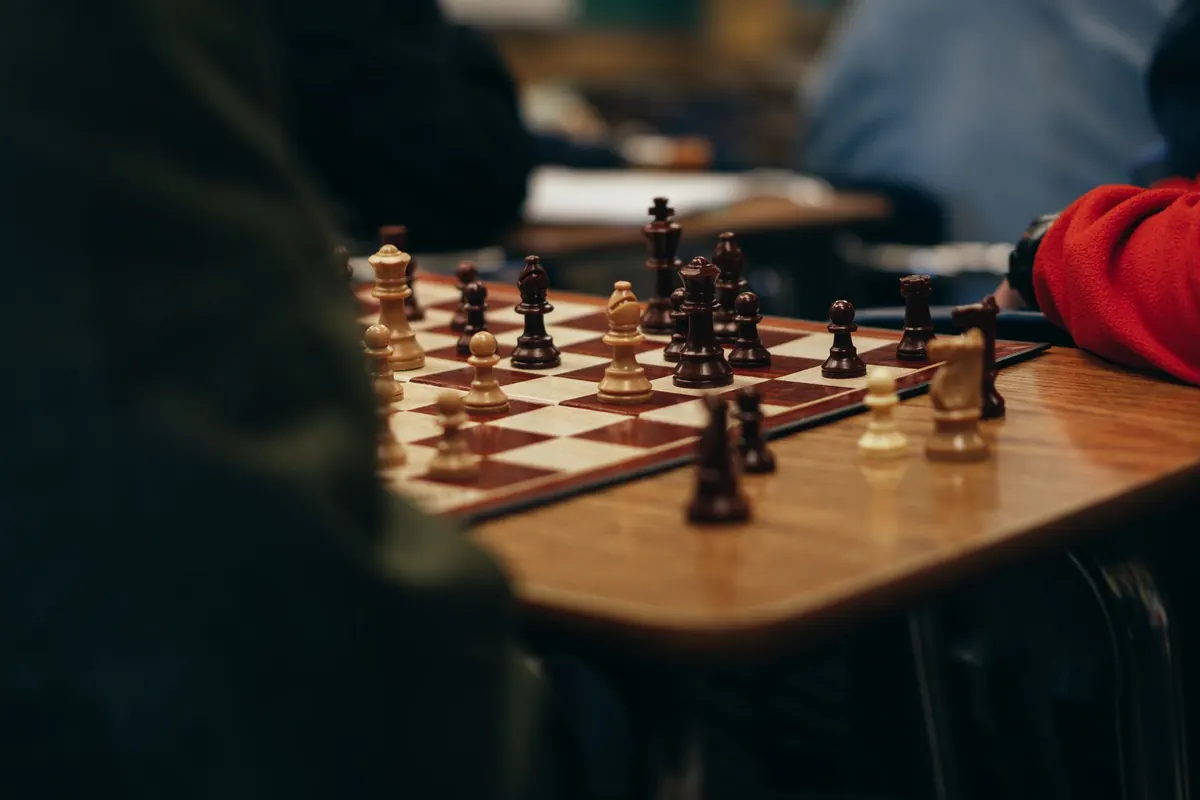
Photo: Pexels / Pixabay