Your clock is ticking. The opening has ended, pieces are developed, and nothing obvious presents itself. You scan for tactics, find none, and move a piece just to do something. We have all played that move. The good news is that a plan does not require genius. It requires information. When you have no idea what to do, stop searching for a brilliant idea and start asking simple questions about the position in front of you.
Every plan grows from an assessment. Before you calculate variations, look at three things:
Answer these honestly. You are not looking for a verdict on the whole game; you are looking for a direction. A plan is simply the most useful way to improve your worst problem or exploit your opponent's.
Pawns are the skeleton of the position. They change slowly, so they tell you what kind of game you are in. If the centre is locked, play usually shifts to the wings. If the centre is open, piece activity and king safety matter more. If you have an isolated queen's pawn, you often want active pieces and a kingside attack before the endgame exposes the pawn. If your opponent has one, you want to trade pieces and steer towards an ending where the weakness can be attacked.
Look for specific features rather than vague descriptions. Is there a backward pawn on an open file? A hole near the enemy king? A majority on one wing? In many Sicilian structures, for example, White's pawns point towards the kingside while Black's point towards the queenside. That does not mean White must attack, but it gives both sides a natural starting point: improve the pieces that support your own pawn break.
Ask: Which pawn break would change the position in my favour? Then work out how to prepare it. That preparation is a plan.
Developed is not the same as active. A knight on f3 may be well placed; a bishop on c1 behind its own pawns is not. Count how many moves each of your pieces needs to reach a good square. The piece that needs the most help often gives you your next move.
Do the same for your opponent. If their queen is active but their rooks are disconnected, you may have time to improve your position before a crisis. If their pieces are swarming around your king, your plan may need to be purely defensive.
Useful questions include:
A plan such as "centralise the rooks and put the knight on d5" is concrete. "Play actively" is not.
King safety decides how much time you have. If your king is safe and your opponent's is not, attacking chances deserve priority. If your king is the exposed one, your first plan may be to trade attacking pieces, block lines, or create an escape square.
Look beyond castling. A king on g1 with pawns on f2, g2 and h2 is usually safe. A king on g1 with a pawn on h3 and a bishop on the long diagonal may not be. Ask what your opponent's most natural attacking move would be, then see whether you can prevent it. Sometimes the best plan is simply to remove the piece that would lead the attack.
King safety also affects timing. If both kings are secure, you can manoeuvre. If one king is vulnerable, you usually need to act before the opponent consolidates.
Once you have assessed the three pillars, write a short sentence in your head. For example: "My pieces are passive, my king is safe, and the pawn structure suggests a queenside break. I will improve my rook, then push b4." That sentence becomes your plan.
Then test it. A good candidate plan should:
If the plan fails one of these tests, adjust it. Plans are not vows. They are working hypotheses.
Some positions genuinely offer no forcing plan. In those cases, do not force one. Improve your position move by move. Put rooks on their best files. Place pawns on squares that restrict the opponent. Bring your king towards the centre in an endgame. Trade off your worst piece.
A holding plan may sound modest, but it is often correct. By making useful moves, you give your opponent the chance to err. When their structure changes or their king becomes loose, a concrete plan will appear. Many wins begin with a series of small improvements rather than a single inspired idea.
When you are stuck, use this routine:
If you practise this, you will stop waiting for inspiration. You will start seeing the position as a set of problems and opportunities. That is what a plan really is: a sensible answer to the position, chosen with confidence and kept flexible.
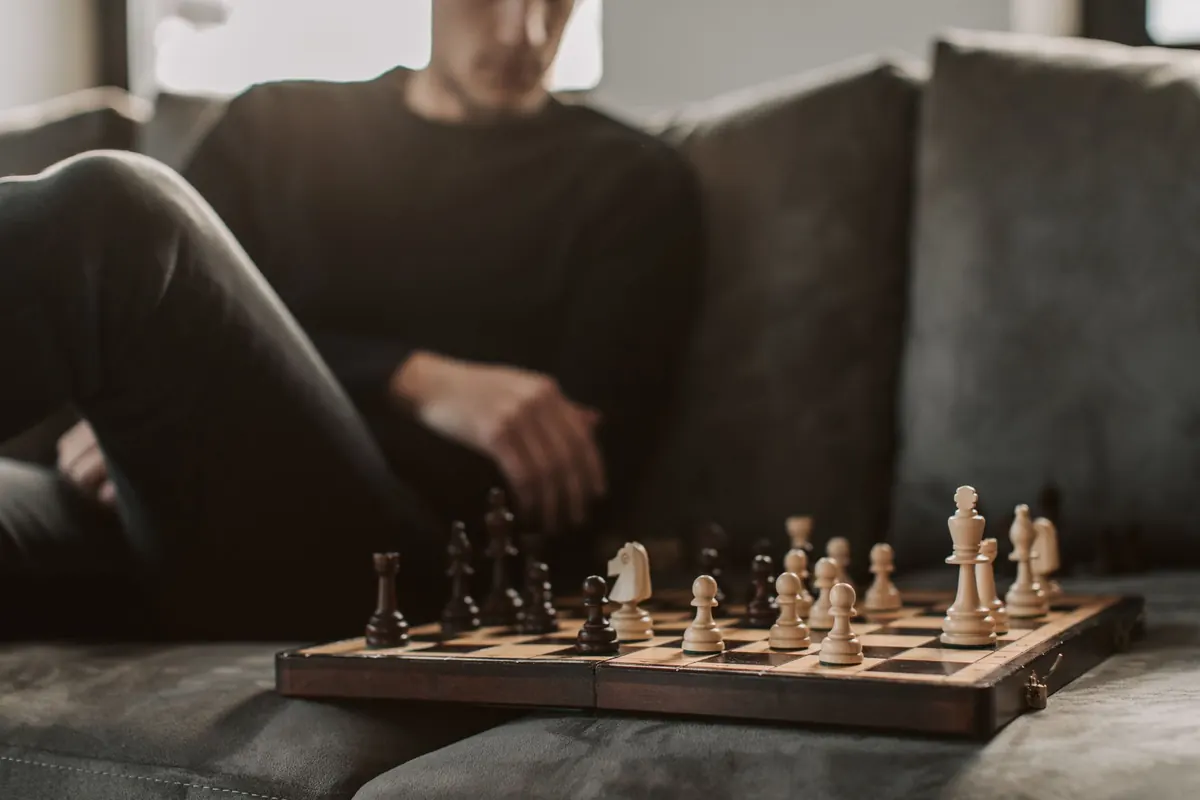
Photo: Vlada Karpovich / Pexels