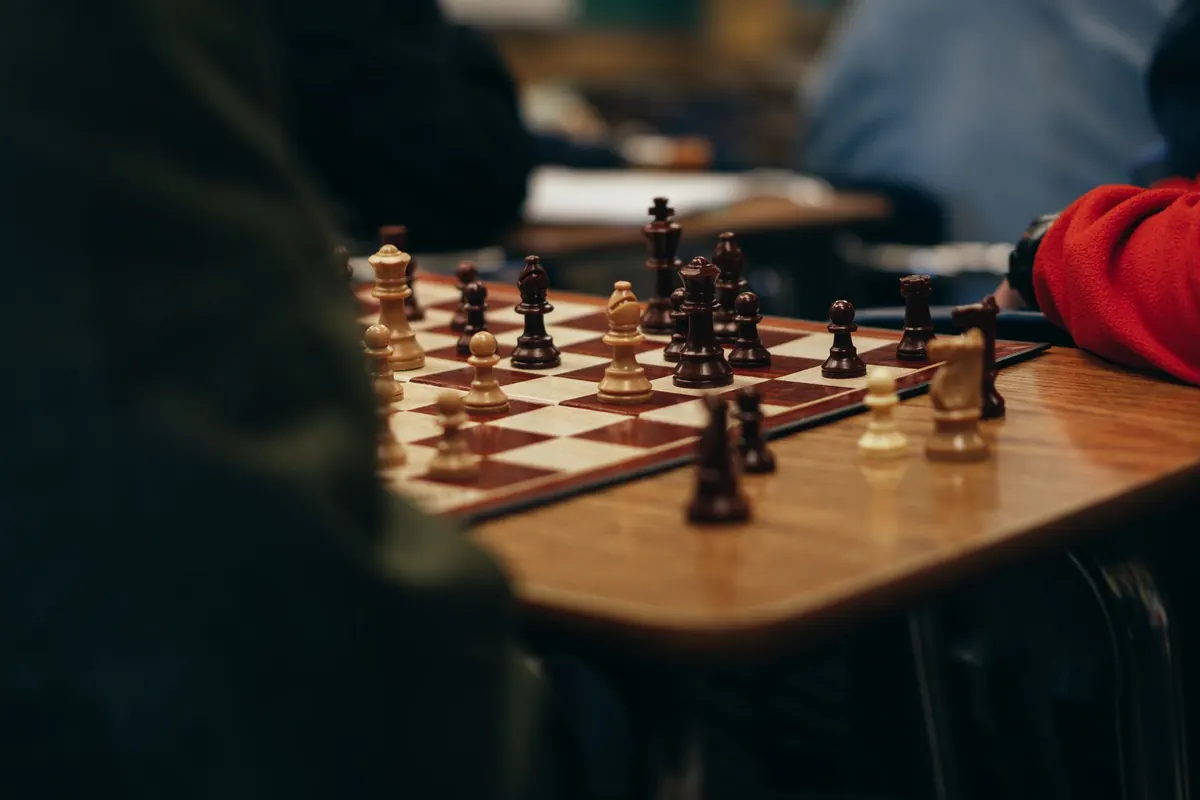
Two openings, one first move, and a decision that shapes your White repertoire for years. After 1.e4 e5 2.Nf3 Nc6, you develop the bishop to c4 or b5, and those two squares lead to very different middlegames. The Italian Game promises rapid development and a direct eye on f7. The Ruy López promises lasting pressure against e5 and a squeeze that can run for forty moves. Both are sound, both are played at the highest level, and neither is objectively better. The real question is which one suits the way you like to play.
The Italian starts 3.Bc4. The bishop points at f7, the tenderest square in Black's camp before castling, and after c3 and d4 White can build a broad pawn centre with pieces already developed. It is a friendly opening: you know where your pieces go and you usually know what you are trying to achieve.
The Ruy López asks a subtler question. After 3.Bb5, the bishop attacks nothing of value yet. It pressures the knight on c6, which defends e5, so Black must decide whether to tolerate the pin, break it with ...a6 and ...b5, or hit back in the centre at once. That single choice generates a dozen major systems, and it explains why the Spanish has sat at the top of opening theory for well over a century.
Play 3.Bc4 and most games follow one of two tracks.
In quiet lines — 3...Bc5, 3...Be7 or 3...d6 — White builds the classic setup: c3, castling short, Re1, then d4 once it is supported, with Nbd2 or a kingside build-up via Nf1-g3. Black counters with ...d6, ...0-0, and then looks for ...Na5 to hit the bishop or ...a6 and ...b5 for queenside space. If White's d4 push gets taken, the position often opens into an isolated queen's pawn or a symmetrical structure. If the centre locks, the two sides usually head for opposite wings, White on the kingside and Black on the queenside.
The sharp side appears after 3...Nf6, the Two Knights Defence. White can grab material with 4.Ng5 and 5.exd5, but Black's compensation is real and the lines are forcing. The Evans Gambit with 4.b4 is magnificent if you enjoy handing over a pawn for fast development, but it demands homework.
Where the Italian rewards club players is the middle ground. The Giuoco Pianissimo is strategically rich and rarely punishes a small inaccuracy. You can learn three or four standard setups, repeat them, and spend your study time on plans rather than memory.
After 3.Bb5, Black's most flexible answers are 3...a6, 3...Nf6 and 3...Bc5. Meet 3...a6 with 4.Ba4 and you are in the Closed Spanish, the heart of the opening. White often keeps the bishop on a4 and prepares c3 and d4, or chooses the slower manoeuvring game with d3, Nbd2, Re1, h3 and Bc2. Black's plan is well defined too: ...b5, ...d6, ...0-0, ...Re8 and ...Bf8 to defend e5, then ...Be6 or a knight tour to g6.
The pawn structure that results — White's e4 and d4 against Black's e5 and d6, with a ...b5 cramp that White attacks with a4 — is one of the most instructive in chess. Whoever understands it better tends to win the middlegame.
The Berlin Defence, 3...Nf6, leads to an endgame after 4.0-0 Nxe4 5.d4 Nd6 6.Bxc6 dxc6 7.dxe5 Nf5 8.Qxd8+ Kxd8 that looks drawish and very much is not. The Marshall Attack, reached by 8.c3 d5 in the Closed, hands White a pawn and Black a long initiative; the theory there runs deeper than most club players will ever need. If you would rather sidestep all of it, the Exchange Variation, 4.Bxc6 dxc6 5.0-0, gives you a symmetrical structure where your plan is a kingside pawn march with f4 and e5, while Black leans on the bishop pair and a queenside majority.
Remember that your opponents at club level rarely know these lines either. Understanding beats recall in almost every game you will play below master strength.
Ask yourself a few honest questions.
Clear, direct answers point to the Italian. A taste for slow strangulation and structure points to the Ruy López.
Whichever you choose, resist the urge to change after one bad game. Both openings repay patience, and both will teach you something about pawn structure that transfers to everything else you play. Pick the one whose typical middlegames you actually look forward to, learn its plans properly, and let the theory catch up with you.
Photo: Jonas Von Werne / Pexels