Tactics are where most club games are won and lost. Not deep opening theory, not twenty-move calculations — just a moment where a piece ends up undefended, or lined up behind something more valuable, and one player notices. Pins, forks and skewers account for a huge share of that. All three are about geometry: where pieces sit in relation to each other. Once you know the shapes, you start seeing them everywhere.
A pin attacks a piece that cannot safely move, because something more valuable sits behind it on the same line. The bishop on b5 eyeing the knight on c6 is the classic picture: the knight shields the king on e8, so it is frozen. You have not won anything yet. You have created a target you can attack again. Think of it as putting a piece under house arrest — it is still on the board, still defending squares, but it cannot run.
The mistake beginners make is to pin a piece and then stop. A pin is not a win; it is a lever. Count attackers and defenders. If you can add one more attacker than your opponent has defenders, the pinned piece falls. A pawn push such as a4–a5 against a knight stuck on c6 is often the simplest way to do it — the knight cannot step aside, so a pawn takes a knight. You can also pile on with a rook or queen along the same file, or use a second pin to paralyze a defender.
One warning: a pinned piece still defends the squares it attacks. A knight pinned against its own king still covers the square beside it, so do not assume you can win material by capturing right next to the enemy king. The pin restricts movement, but it does not erase the piece's influence.
If the piece behind the pinned one is the king, the pin is absolute: the pinned piece cannot legally move at all. If a queen or rook sits behind it, the pin is relative: the piece can move, but it costs material. The distinction matters when you are on the receiving end. Against a relative pin you can often break free with tempo, by moving the piece with a threat or blocking the line, whereas an absolutely pinned piece is simply stuck until the line is broken.
For example, a knight pinned to a queen by a bishop can sometimes jump away with check, giving the opponent no time to capture the queen. But a knight pinned to a king has no such escape. Always check what is behind the pinned piece before you decide how much pressure to apply.
Once you have a pin, you need a plan. Here are the standard ways to convert it into something concrete:
A fork is one piece attacking two targets at once. Your opponent can only save one. Knights are the great forkers because their attack pattern is awkward and easy to overlook: a knight landing on c7 gives check to a king on e8 and attacks a rook on a8 in the same move, and the knight is usually safe there because nothing defends the square.
Knights are not the only forkers. A pawn advancing to d6 forks pieces on c7 and e7 — cheap, effective, and missed constantly, because nobody fears a pawn until it takes something. Queens fork all the time, often from a check, and a queen that gives check while attacking a loose rook is doing two jobs with one move. Bishops and rooks can fork too, especially when they attack a king and a rook along the same line, though that is technically a skewer if the king is in front.
The key idea is tempo. A plain attack gives your opponent time to move the piece. A fork does not, because it creates two threats simultaneously. If one of those threats is check, the fork is almost always winning, since the king must be addressed first. That is why a knight fork that delivers check is the most common way to win a queen in beginner games.
The knight fork on c7 (or c2 for Black) is the classic beginner trap: it hits the king on e8 and the rook on a8. Another famous pattern is the royal fork, where a knight attacks the king and queen at the same time. Pawn forks are less glamorous but just as deadly: a pawn on d6 attacking a knight on c7 and a bishop on e7, for instance, can win a piece because the pawn is worth so little that any trade is good for you.
To spot forks, look for enemy pieces sitting on squares a knight's move apart, or pieces that share a diagonal or file that your queen or bishop can exploit. Loose pieces — undefended ones — are the usual victims.
The best defense is prevention. Keep your pieces defended, avoid leaving loose pieces around, and watch out for knight moves that land on squares like c7, f7, c2, and f2. Before you move a piece, ask: does this leave two of my pieces on squares that a knight could attack at once? If the answer is yes, you may need to move them or add a defender. Also beware of pawn pushes that create forks — a small pawn can be a big problem.
A skewer is like a pin turned inside out. Instead of a lesser piece shielding a more valuable one, the more valuable piece is in front. You attack it, force it to move, and then capture the piece behind it. The classic example: a rook on e1, a king on e8, and a queen on e7. The rook checks the king; the king must move off the e-file, and the rook then takes the queen. The king was the front piece, the queen the prize behind.
Skewers are especially common with checks because the king has no choice but to move. Bishops and rooks are the usual skewering pieces, but queens and even knights can do it in rare cases. The geometry is simple: two enemy pieces on the same line, with the more valuable one closer to your attacking piece. Look for kings and queens lined up on a file, rank, or diagonal.
One practical tip: when you give a check, always look at what is behind the king. If a queen or rook is sitting on the same line, the check might be a skewer that wins material after the king steps aside. Many beginners give checks without realizing they had a winning skewer available.
Pins, forks, and skewers are not separate tricks to memorize. They are all expressions of the same idea: pieces on lines, pieces on squares, and the geometry between them. Train your eye to see those relationships, and the tactics will find you. Start with simple puzzles that focus on each motif, then move to mixed positions where you have to spot which pattern applies.
Here are a few habits that will speed up your improvement:
None of this requires deep calculation at first. You do not need to see ten moves ahead. You need to see one move clearly: the pin, the fork, the skewer. Once you notice it, the follow-up usually plays itself. That is the quiet secret of club chess — the player who sees the simple tactic first usually wins.
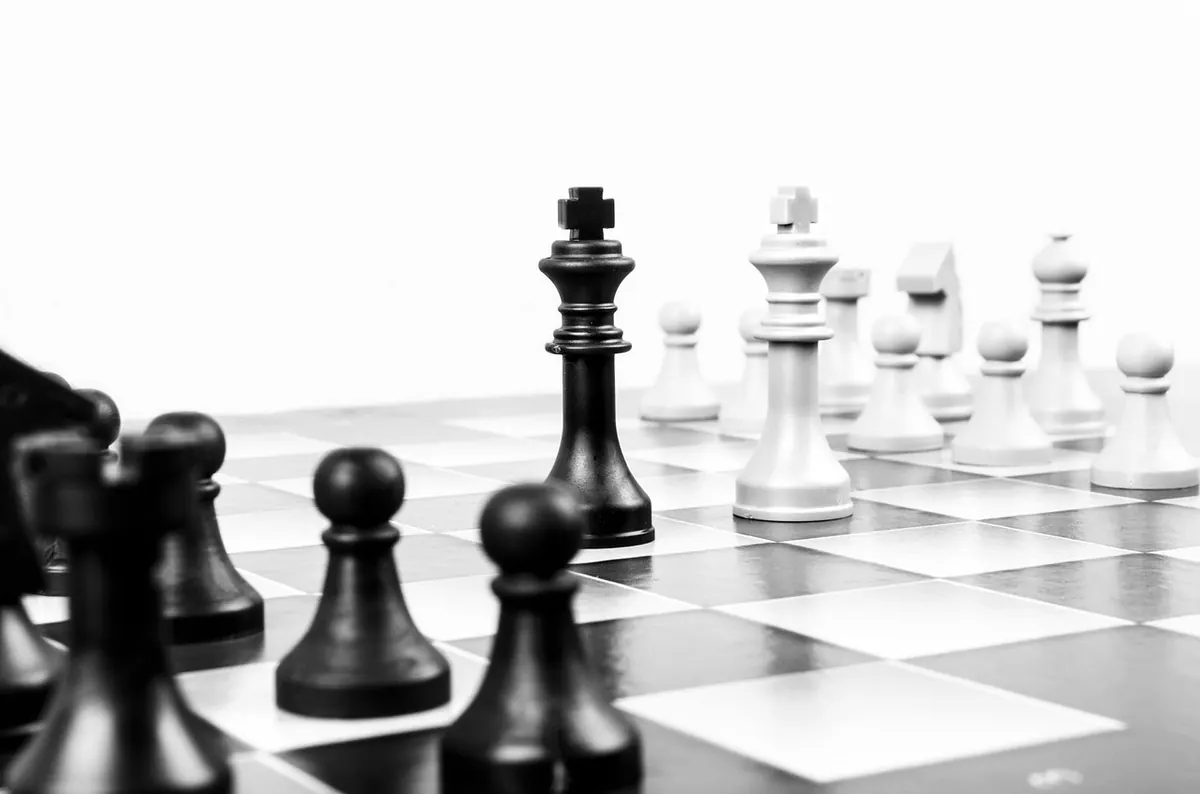
Photo: 422737 / Pixabay